


Platings > by Metal > Gold Plating (Au)
Gold Plating (Au)
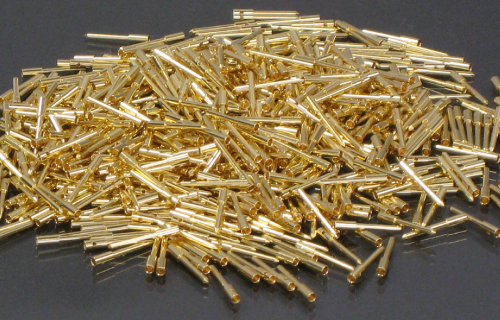
Gold is both soft and easily processed. Moreover, it exhibits exceptional chemical stability and corrosion resistance, ensuring its aesthetic appeal remains intact for extended periods. Consequently, it has served as a material for ornaments and coins since ancient times. Another notable characteristic is its high electrical and thermal conductivity.
Despite being such a remarkable metal, gold is renowned for its low yield and high cost. However, through a technique called plating, it's possible to impart these outstanding properties to materials in small quantities.
By gold plating, materials can acquire the following characteristics: corrosion resistance, low contact resistance, strong bonding properties, high conductivity, sealing abilities, high-frequency characteristics, high reflectivity, and thermal conductivity.
These characteristics obtained through gold plating find applications in connectors, sensor electrodes, semiconductor parts, optical components, medical devices, and more.
Although gold is expensive, Mitsuya enables cost reduction by controlling plating film thickness and selectively performing gold plating. Additionally, Mitsuya offers a wide range of gold plating options with unique characteristics such as hard gold plating, high-purity gold plating, and gold plating with increased reflectance.
Mitsuya provides 25 types of gold plating to easily showcase these characteristics. Clients can select the most suitable gold plating based on their product specifications, and Mitsuya can also propose optimal solutions.
Available platings
 Bright Gold Plating (metallization) (containing Cobalt)
Pick up properties
We will introduce the property data about the gold plating (au) as follows.
These help you to find the property which you need.
Cobalt-Free / Nickel-Free
We address metal allergy concerns by offering Cobalt and Nickel-Free Hard Gold plating. We also provide Direct Gold Plating on stainless steel (SUS), eliminating the need for a nickel underlayer entirely.
Contact Resistance
Our gold plating solutions are designed to deliver reliable performance by achieving significantly low contact resistance values, ensuring optimal signal transfer and long-term electrical integrity.
Hardness
Hard gold plating, achieved by adding cobalt and nickel to boost hardness, is perfectly suited for applications requiring high wear resistance, including connectors, contacts, and probe pins. Our offerings span from soft gold to this specialized hard gold, ensuring we match the plating to your exact requirements.
High-Temperature Solder
Gold-Tin (AuSn) is a premier offering in our high-temperature solder plating lineup. It provides a reliable, lead-free option essential for step soldering applications. Our AuSn alloy plating features uniform composition and even thickness, resulting in consistent, predictable melting characteristics and high reliability for elevated temperature applications. In addition to AuSn we offer a variety of other high-temperature solder platings tailored to meet your specific application requirements.
Partial Gold Plating
Where the application allows, partial gold plating offers an effective balance, delivering required performance levels with significant cost savings.
Purity
Our selection of gold plating solutions offers a purity spectrum ranging from 70% up to 99.9&. Depending on the chemical process selected, clients can choose between pure gold and specialized alloys. This allows you to specifically control critical characteristics such as hardness, optical reflection, bonding strength, and solder melting point.
Reflectance
For components like reflectors and condensers, we recommend our highly reflective gold plating. It offers significantly higher light reflectance than standard bright gold.
Solderability
We can recommend the appropriate type and exact thickness of gold plating tailored to your specific application. Our consultative approach ensures that the final deposit provides the optimal balance of characteristics needed for superior, highly reliable solderability.
Sealing Treatment
Thin gold plating can create pinholes, causing corrosion in the underlying layers. We enhance corrosion resistance by sealing these holes with custom processes (e.g., water-soluble or non-aqueous), based on your preference.
 Mail Form
 +81-3-6421-7197